Not Your Mama’s Stew: Smoked & Elevated Bosnian Grašak
The Story: Elevating Bosnian Grašak into a Smoked Beef Stew
I evolved my favorite pea stew from my childhood because my years managing professional kitchens changed how I view “simple” comfort food. In a traditional Bosnian home, Grašak is a Tuesday night staple—reliable, humble, and made entirely on the stove. But after working alongside chefs who respected the product enough to go the “long way,” I realized this dish was the perfect canvas for wood fire. This version honors those childhood flavors but introduces a level of depth that only real smoke can provide. I take the beef outside for thirty minutes over a low wood flame before it ever hits the cast iron. It’s no longer just a humble stew; it’s a technical exercise in layering char, smoke, and residual heat to keep the ingredients in their greatest form.
Order of Operations
The Fire | 3 Hours Out
Build a wood fire using oak or cherry to a medium heat. Season the marbled chuck roast with salt and a little pepper—if your heat is too high, the pepper will burn and create a bitter profile in your finished broth. Place the beef over the smoke and flame for 25 to 30 minutes, moving it continuously to avoid any localized burning. If you have an official smoker, this is a great time to use it.
The Sear | 2.5 Hours Out
Remove the meat from the fire and let it rest momentarily before searing it in a heavy Dutch oven with a neutral oil. Brown the edges of the whole roast to create a uniform bark, then remove the beef and set it aside. You may cube the beef at this point to ensure it reaches fork-tender status more efficiently during the braise. In the same pot, sauté minced yellow onions and sliced carrots until they soften and begin to pick up the rendered beef fat.
Blooming the Spice | 2 Hours Out
Stir in your smoked jalapeño powder directly into the hot oil. This process releases fat-soluble oils that ensure the heat is fully integrated into the sauce rather than floating on top. Add your cubed potatoes and the beef back to the pot, then submerge everything in six cups of high-quality beef bone broth.
The Slow Simmer | 90 Minutes Out
Bring the liquid to a brief boil and then immediately drop to a very low simmer. Cover the Dutch oven and wait roughly 90 minutes. The stew is finished only when the beef is fork-tender; use a physical fork to test the resistance of the muscle fibers rather than a knife.
The Residual Finish | 5 Minutes Out
Turn off the heat entirely before adding the frozen peas. Stir them in and allow them to sit in the residual heat for exactly three minutes. This “carryover” cooking method ensures the peas stay a vibrant, snap-green rather than the mushy, gray-green texture of a traditional over-boiled stew.
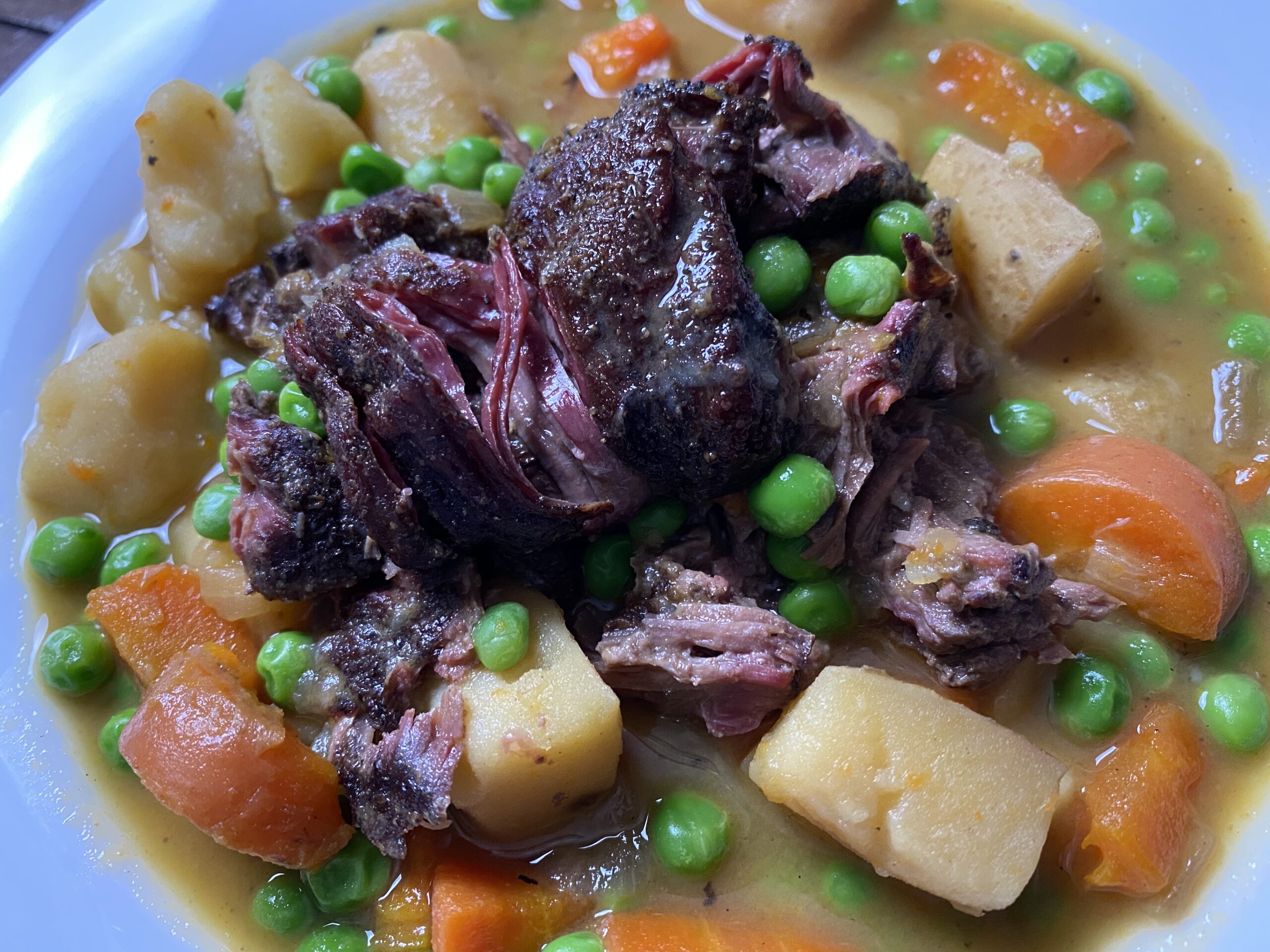
The Parts
The Protein: Marbled Chuck Roast for Beef Stew
Fire: Oak or Cherry wood
Heat: 1 tsp homegrown (or store bought) smoked jalapeño powder
Aromatics: 1 yellow onion, 4 carrots
Bulk: 6 yellow potatoes, skin on
Finish: 1 bag frozen peas
Liquid: 6 cups Beef Bone Broth
The Technique
1. Wood Fire Foundation and Surface Smoke In this version, the fire is an ingredient, not just a heat source. By placing the whole chuck roast over oak or cherry wood for thirty minutes, you are allowing the smoke particles to bind to the surface fats. This creates a “cold smoke” profile that provides the foundational seasoning for the entire broth later on.
ON THE BURNER: Stovetops lack the dry heat and aromatic compounds of a real fire. Those 30 minutes of wood smoke provide the base seasoning for the entire broth later. This is a difficult step to replicate without the real thing. This is what differentiates a “Traditional Bosnian Grašak” from a “Smoked Beef Stew”.
2. The Secondary Bark (Maillard Reaction) Once the meat has absorbed the smoke, the goal is to create a complex crust through searing. When the smoke-conditioned meat hits the hot oil in your Dutch oven, you initiate a secondary Maillard reaction. This process doesn’t “seal in juices,” but it does create the savory amino acids and sugars that dissolve into the stew as it simmers, giving the broth a deep, rich body.
3. Blooming Fat-Soluble Heat The use of smoked jalapeño powder is a technical choice that requires proper activation. If you add dry spices directly to the broth, the heat stays trapped and tastes disconnected. By stirring the powder directly into the hot oil after sautéing your vegetables, you “bloom” the spice. This releases the fat-soluble essential oils and capsaicin, ensuring the heat is fully integrated into every spoonful of the final sauce.
4. Maintaining Color and Snap (Residual Heat) The most common mistake in a long-form stew is boiling the peas until they turn gray and mushy. To prevent this, we utilize carryover cooking.
ON THE BURNER: Boiling peas rupture their cell walls, leading to a gray color and mushy texture. Using residual heat or carryover cooking, allows the peas to reach the ideal temperature while keeping their color vibrant and their skins snappy.
More Bosnian Beef Stew and Braise Recipes
If you aren’t ready to fire up the wood grill today or if you’re looking for the simple, comforting stovetop version I grew up with, you can find my Traditional Bosnian Grašak Recipe here. It’s the same soulful foundation, built for a busy Tuesday night in the kitchen rather than a technical weekend project.
Damir's Pour 🍷
The Balkan Choice | Vranac (Montenegro) The wood-smoke and the heat of the smoked jalapeño powder require a wine with significant structural weight to avoid being washed out. A Montenegrin Vranac is a deep, “inky” red with dark fruit notes like blackberry and sour cherry that stand up to the charred beef. Its firm tannins and slight earthiness are a technical match for the oak-smoke infusion we built in the Dutch oven.
The Accessible Choice | Cabernet Sauvignon (Napa Valley) If you are looking for a more familiar profile, a bold Napa Cabernet Sauvignon provides the necessary intensity. The high-tannin structure of the Cabernet is technically required to cut through the marbled fat of the chuck roast, while the inherent notes of cedar and tobacco mirror the smokiness of the wood fire.