Seared Scallops with Ramp & Pea Purée
The Story: Chicago Ramp Recipes & Garden Secrets
This dish is an exercise in timing. In the Midwest, ramps are the first sign of life after a long winter, but their peak window is notoriously short, usually lasting only 3 to 4 weeks between mid-April and mid-May. I source mine from Nichols Farm at the Evanston Farmer’s Market the moment they appear. They are sustainably foraged from the woodlands of Marengo, Illinois, bringing that concentrated, wild-garlic bite of the Midwest straight to the plate. Pairing their aggressive, wild-garlic bite with the sweetness of spring peas creates a high-acid profile that perfectly cuts through the richness of the sea scallops. We also grow chives in our garden. Every year when they bloom, I usually just snack on them while gardening, rarely thinking to bring them into the kitchen. Most people that come over and visit the garden in the spring/summer don’t believe how delicious, peppery and mild the blossoms taste compared to chives.
Pairing that “hidden” garden flavor with the aggressive, wild-garlic bite of a fresh ramp created the high-acid profile I needed to cut through the richness of the sea scallops. It’s a dish rooted in those fleeting, peak-spring flavors that give you something to look forward to and plan for, during the cold winter months.
Order of Operations
30 Minutes Out | The Prep
Pat the scallops bone-dry on all sides with paper towels and place them on a wire rack in the fridge, uncovered. This is the first and most vital step for a glass-like sear. While those chill, gently pull your garden chive blossoms into individual florets and submerge them in a small bowl of champagne vinegar and a pinch of sugar to begin the quick-pickle process.
20 Minutes Out | The Base
Bring a small pot of salted water to a rolling boil. Prepare a large bowl of ice water nearby. Blanch the peas for exactly 60 seconds until they turn a vibrant, electric green, then immediately plunge them into the ice bath to stop the cook. In a separate skillet, sauté the white ramp bulbs in a knob of butter over low heat until they are translucent and aromatic, then blend with the chilled peas, a splash of heavy cream, and lemon zest until silk-smooth.
10 Minutes Out | The Gremolata
Finely mince your fresh parsley, garlic, and lemon zest. Do this just before service so the parsley doesn’t wilt and the garlic remains sharp and potent. Set aside at room temperature.
3 Minutes Out | The Service
Bring a cast-iron or heavy stainless skillet to high heat with a high-smoke-point oil. Once the oil shimmers and barely begins to wisp, add the scallops. Flip after 90 seconds, add a tablespoon of cold butter to the pan, and spoon the foaming butter over the tops for the final 30 seconds of cooking.
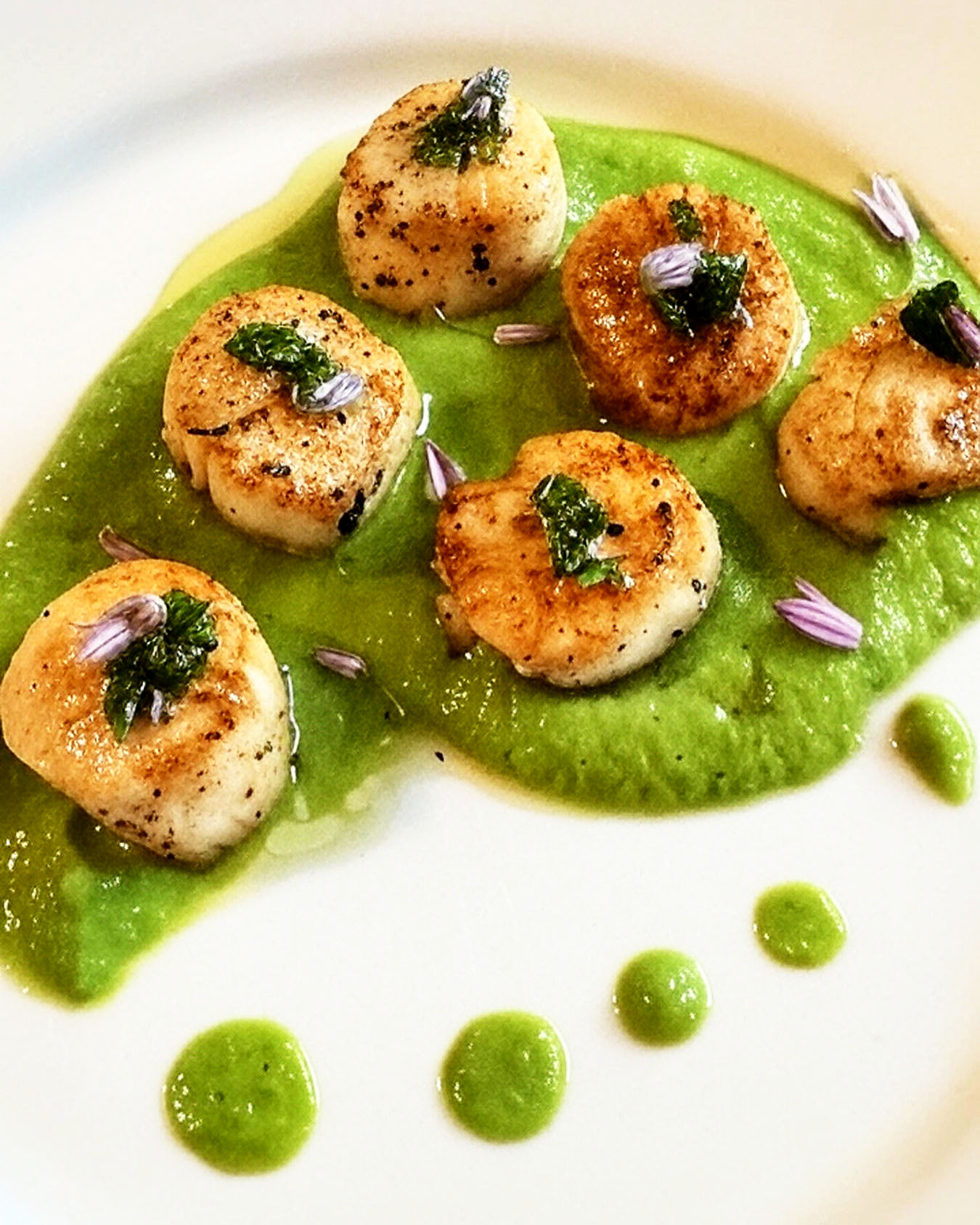
Immediate | Plating Construct the plate while the scallops are at peak temperature. Purée first, scallops second, finished with the gremolata and pickled blossoms.
The Parts
Protein: 1 lb U-10 Dry-Packed Sea Scallops (Avoid “wet” scallops; the chemical brine prevents a proper sear).
The Purée: 2 cups frozen peas (blanched), 1 bunch Nichols Farm ramps, heavy cream, lemon zest.
The Gremolata: Fresh parsley, lemon zest, minced garlic.
The Acid: Chive blossoms, pickled 30 minutes prior to plating.
The Technique
1. Scallop Preparation & Dehydration Using paper towels, pat each scallop until the surface no longer feels slick or damp. Place them on a wire rack or a paper-towel-lined plate in the refrigerator for at least 30 minutes, uncovered. You are looking for the surface of the meat to feel slightly tacky (the “pellicle”) before they ever hit the pan.
ON THE BURNER: This fridge-dry is a very helpful step for the Maillard reaction. Surface moisture is the enemy of a crust; if the scallops go in wet, they will steam from the outside in, leaving you with a rubbery, grey protein instead of a deep, glass-like golden sear.
2. The Chive Blossom Quick-Pickle
Gently pull the purple florets away from the green base stems. In a small bowl, whisk together two tablespoons of champagne vinegar and a generous pinch of granulated sugar until dissolved. Submerge the florets and let them macerate at room temperature for at least 30 minutes. The florets should soften slightly while their color becomes an even more vibrant, translucent purple.
ON THE BURNER: Chive blossoms can be quite pungent if eaten raw and whole. Quick-pickling them “opens up” the flower, softening the texture and adding a bright hit of acid that mirrors the lemon in the gremolata. It transforms a “pretty garnish” into a functional element of the dish’s flavor profile.
3. Executing the Ramp & Pea Purée
Bring a small pot of salted water to a rolling boil and prepare a large bowl of ice water nearby. Blanch the peas for exactly 60 seconds until they turn “electric” green, then immediately plunge them into the ice bath to lock in the color and sugar. In a separate skillet, sauté the white ramp bulbs from Nichols Farm in a knob of butter over low heat until they are soft and translucent. Blend the chilled peas, sautéed bulbs, a splash of heavy cream, and lemon zest in a high-speed blender until the consistency is velvet-smooth and holds its shape on a spoon.
ON THE BURNER: The ice bath (shocking) is vital for sugar preservation. If peas cool slowly, their natural sugars convert to starch, resulting in a grainy, “mealy” purée that tastes like a dusty pantry rather than a spring garden.
4. The Parsley & Lemon Gremolata
Finely mince one cup of Italian flat-leaf parsley (stems only removed), one medium garlic clove, and the zest of half a lemon. Use a sharp knife and a light touch; you want clean, dry “crumbs” of aromatics, not a bruised, wet paste. Combine the three in a small bowl and toss with a fork to ensure an even distribution. This is a “dry” condiment and must be prepared as close to service as possible to prevent the parsley from wilting.
5. The Professional High-Heat Sear
Bring a cast-iron or heavy stainless skillet to high heat with a high-smoke-point oil, I usually use avocado oil. Once the oil shimmers and begins to wisp smoke, add the scallops clockwise starting at the 12 o’clock position. Press down lightly with a spatula for the first 10 seconds to ensure total surface contact. After 90 seconds, a golden rim should appear at the base. Flip once, add a tablespoon of cold butter and the green ramp leaves to the pan. Spoon the foaming butter over the scallops for the final 30 seconds.
ON THE BURNER: If the scallop “grabs” the pan when you try to flip it, it is not ready. The protein physically releases its bond from the metal once the crust is fully formed. Patience ensures you don’t tear the meat.
6. Final Construction (Plating)
Spoon a warm pool of the purée into the center of the plate, creating a slight well with the back of the spoon. Nestle six scallops into the purée, following the clockwise spacing of the sear. Top each with a precise pinch of the fresh Gremolata. Finish by scattering the Pickled Chive Blossoms around the purée and on top of the scallops. The purple florets provide the necessary acid to cut through the butter-basted richness of the dish.
ON THE BURNER: Zero Waste Do not discard the pickling liquid. The champagne vinegar is now infused with floral chive notes; use it as a base for a vinaigrette or to dress raw radishes for your next meal.
Explore More Seasonal Recipes and Technical Manuals
If you want to apply this same level of technical timing to a winter staple, check out my recipe for Sarajevo Sarma. It is another exercise in patience and precision that honors the “long way” of Bosnian cooking through slow-simmered, complex layers. You can also see how we apply high-rigor techniques to everyday comfort food in my manual for Traditional Bosanski Grašak.
Damir's Pour 🍷
The Balkan Choice | Malvazija Istriana If you want to experience the dish as intended, seek out this Croatian white. It leads with notes of crisp green apple and apricot, moving into a floral acacia aroma, and finishing with a distinct hint of salted almonds. Its natural salinity acts as a mineral “seasoning” that draws out the sweetness of the seared scallops.
The Accessible Choice | Sauvignon Blanc (Sancerre Style) For a bottle you can find at any local shop, reach for a high-acid Sauvignon Blanc from the Loire Valley. These wines are famous for their “flinty” or stony finish and grassy aromas, which act as a direct flavor bridge to the ramps and spring peas. The high acidity functions as a liquid lemon squeeze, cutting through the butter-basted richness of the protein.
The Middle Ground | Albariño If you want the saltiness of the Balkan choice but the bright citrus of the Sauvignon Blanc, look for a Spanish Albariño. These vines are grown along the coast and “breathe” in sea salt, resulting in a wine that is essentially designed by nature to be paired with seared shellfish.